

Every high-growth digital platform and marketplace encounters a familiar ceiling.
Blended Return On Ad Spend (ROAS) is strong, customer acquisition costs (CAC) remain stable, and increasing ad spend linearly delivers predictable top-line revenue growth. Leadership approves a capital boost to double or triple monthly acquisition budgets.
Then performance collapses. ROAS drops, CAC spikes, and cash flow tightens, even though ad creatives and click-through rates remain solid.
This isn’t an algorithm issue or creative fatigue. It’s the Operational Debt Trap: a structural mismatch between aggressive user acquisition scaling and the underlying financial and working capital capacity supporting it.
What Is Operational Debt in Digital Ecosystems?
Operational Debt occurs when customer acquisition velocity outpaces backend financial liquidity. At moderate spend, small inventory lags, payment settlement delays, or supplier cash bottlenecks remain hidden.
Scaling ad budgets stress-tests your entire ecosystem architecture, converting minor operational friction into direct conversion penalties:
- Capital Bottlenecks: When merchants or digital sellers hit liquidity walls, they reduce acquisition and inventory investments, causing platform-wide ad performance and GMV growth to stall.
- Inventory Exhaustion: As hero SKUs or top merchant offerings sell out faster than secondary supply, paid campaigns continue driving traffic to out-of-stock options. On-site conversion rates plummet while ad spend burns.
- Cash-Conversion Lag: Scaling spend widens the gap between paying for ad impressions and collecting settled payments. Longer payback windows starve working capital, delaying reorders and eroding customer LTV through fulfillment delays.
Bridge the Gap: Embedding Capital directly at the Point of Growth
Escaping the Operational Debt Trap requires moving beyond disconnected, siloed financing. Digital platforms, SaaS tools, and marketplaces must integrate real-time financial capacity directly into their user workflows.
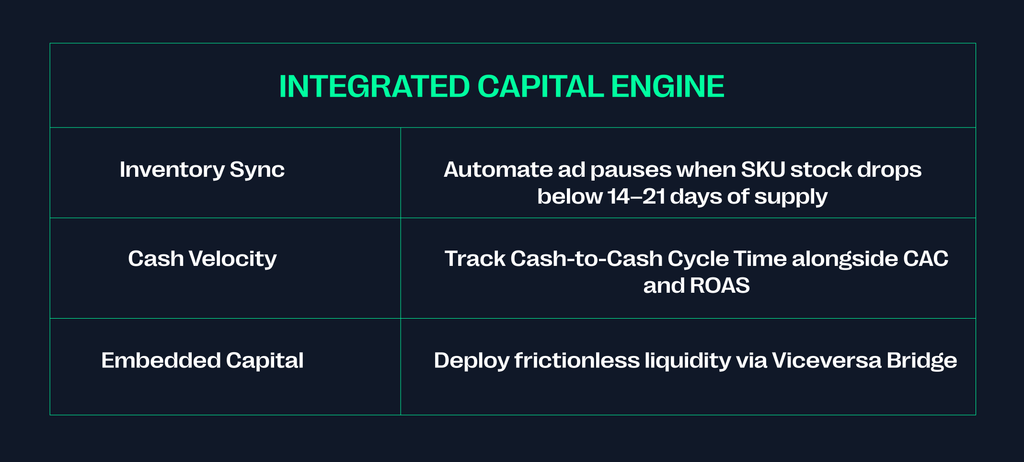
- Align Ad Spend with Real-Time Inventory: Connect marketing intelligence directly with supply chain telemetry. Automatically shift ad budgets away from low-stock hero products to high-margin secondary inventory before variants run dry.
- Track Cash Velocity Alongside ROAS: Treat ad spend as a working capital investment. Monitor Cash-to-Cash Cycle Time to ensure liquidity keeps pace with media spend.
- Embed Frictionless Growth Financing: Rather than forcing businesses to seek external loans or sell equity, platforms can embed non-dilutive Revenue-Based Financing natively into their product interfaces, empowering users to fund inventory and ad spend at the exact moment of demand.
Scale Without Capital Constraints
Paid ads don’t stop converting because marketing fails; they stop converting when acquisition outpaces operational and financial bandwidth. By embedding flexible capital directly where growth happens, platforms ensure their digital merchants scale safely, sustainably, and frictionlessly.
Empower your platform’s growth engine with embedded financial architecture. Unlock instant, data-driven liquidity natively inside your product with Viceversa Bridge.
Looking to add growth capital to your platform?
Discover how Viceversa’s embedded infrastructure lets you offer seamless funding options to your users without the engineering overhead.
Similar stories
We are proud to share stories of our open network of entrepreneurs who have used Viceversa’s funding to grow their digital businesses.



Want to save 57 days a year?
2 out of 3 businesses spend about 60 days a year only pitching for and accessing funds*. With Viceversa, you do it in 3.
*Source