

In today’s fast-moving digital economy, speed is everything. E-commerce merchants need instant access to inventory capital, SaaS platforms want to offer embedded growth financing to their users, and digital lenders face pressure to approve applications in minutes, not days.
Yet, behind every seamless funding decision lies a complex, high-stakes discipline: underwriting.
Traditionally, risk evaluation required expensive in-house risk teams, manual data collection from endless spreadsheets, and rigid statistical models that took months to update. Today, that legacy approach is no longer sustainable.
Enter Underwriting-as-a-Service, a plug-and-play, AI-driven model changing how companies evaluate financial health, manage risk, and deploy capital at scale.
What is Underwriting-as-a-Service?
Underwriting-as-a-Service delivers institutional-grade risk assessment, algorithmic evaluation, and data integration directly via APIs. Rather than spending years building custom risk models, hiring armies of data analysts, or integrating individual financial platforms one by one, companies can leverage UaaS to instantly evaluate the creditworthiness, performance, and risk profile of digital businesses.
At its core, UaaS turns risk evaluation into an infrastructure service, as simple to integrate as an online payment gateway.
By combining machine learning, real-time platform data (from Stripe, Shopify, Google Ads, bank feeds, and accounting tools), and automated rule engines, UaaS enables automated, high-precision risk decisions in real time.
Why Legacy Risk Models Fall Short in the Digital Era
To understand the rise of UaaS, look at where traditional underwriting struggles:
- High Operational Expense: Building and maintaining modern AI-powered underwriting infrastructure requires millions in engineering and data science overhead.
- Incomplete Data Snapshots: Legacy credit scoring relies on historical, lagged data – like past tax returns or quarterly balance sheets. Digital businesses move too fast for quarterly snapshots.
- Manual Bottlenecks: Manual data entry and inbox-driven risk reviews slow turnaround times. In digital finance, a 48-hour delay in funding can mean a lost customer.
- Siloed Systems: Traditional systems struggle to ingest structured and unstructured data from diverse marketing, revenue, and banking channels simultaneously.
The 4 Key Components of Modern UaaS
A complete UaaS platform handles the entire decision workflow from ingestion to portfolio monitoring:
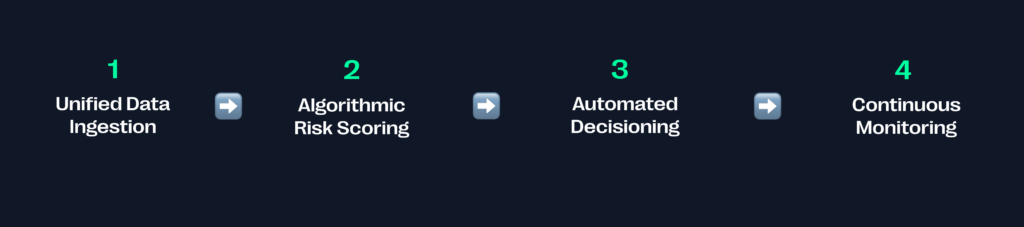
- Unified Data Ingestion: Automated API connectors pull live financial and operational signals directly from platforms like Stripe, Shopify, WooCommerce, Xero, and bank feeds, eliminating manual uploads.
- Algorithmic Risk Scoring: Machine learning engines analyze real-time signals, such as customer acquisition cost (CAC), lifetime value (LTV), revenue churn, chargeback rates, and cash-flow health, to generate precise risk scores. Proprietary engines built specifically for digital assets, like Viceversa’s Athena, demonstrate how deep data integration can evaluate thousands of performance metrics in seconds to pinpoint true growth potential.
- Automated Decisioning: Configurable rule engines match risk scores against pre-set risk appetites, generating instant funding approvals, custom credit limits, or automated flag referrals for human review.
- Continuous Monitoring: Rather than stopping at the initial bind or payout, UaaS continuously monitors the borrower’s health in real time, alerting teams to emerging churn risks or sudden drops in performance.Traditional business loans take weeks of paperwork and rigid repayment schedules that don’t match the seasonal dips of digital commerce. Embedded working capital gives merchants access to liquidity in days, right when they need to purchase stock or scale operations. Because repayments scale naturally with their sales, their cash flow margins remain protected.
The Strategic Advantage: Who Benefits from Underwriting as a Service?
1. Embedded Finance & SaaS Platforms
Vertical SaaS platforms and B2B marketplaces can now offer capital, revenue-based financing, or terms-based extensions directly inside their user dashboards without taking on credit engineering overhead.
2. Digital Lenders & Growth Capital Funds
Investment funds and alternative lenders can scale their asset deployment significantly while keeping operational overhead lean and maintaining disciplined loss ratios.
3. E-Commerce Aggregators & Ecosystems
E-commerce ecosystems gain complete, real-time visibility into the trajectory of candidate brands, backing winners earlier while mitigating downside risk.The era of forcing digital merchants to step outside their primary software ecosystems to beg traditional banks for capital is coming to an end. The future belongs to platforms that can anticipate their users’ operational needs and provide solutions instantly.
Looking Ahead: The Future of Smarter Capital Allocation
As financial markets become more data-driven, success won’t belong to those with the most capital, but to those who can evaluate risk the fastest and most accurately.
Underwriting-as-a-Service shifts risk management from a slow, administrative bottleneck into a growth accelerator. By letting advanced AI handle complex data processing, organizations can focus on what matters most: building relationships, launching products, and empowering digital entrepreneurs to thrive.
Looking to automate risk decisions across your platform?
See how Viceversa’s Athena engine turns complex data streams into instant, reliable credit decisions for your users.
Similar stories
We are proud to share stories of our open network of entrepreneurs who have used Viceversa’s funding to grow their digital businesses.


Want to save 57 days a year?
2 out of 3 businesses spend about 60 days a year only pitching for and accessing funds*. With Viceversa, you do it in 3.
*Source